
Razani Empire
- Game Tag
- EGA
- Capital
- Durobaeraste
- Ruler
- Rhuzemes Razani
- Government
- Imperium
- Primary Culture
- Eagelian
- Faith
- The First Emperor
- Territory
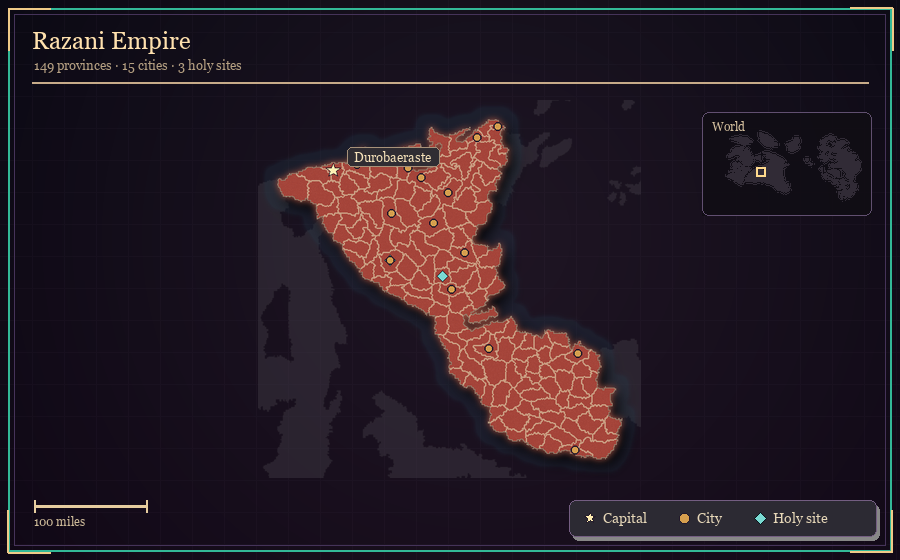
- 149 controlled provinces at start.
- Levy Composition
- Light Infantry 55%, Heavy Infantry 30%, Light Cavalry 15%
The Razani Empire is a Geallian empire and one of the two principal successors of the Zani Empire. Its rulers claim to be the true heirs of Zanis, preserving Imperial Zanic at court even as the rival Nazani Empire increasingly used the local Nazani language.
Formation
The Razani-Nazani split began after The Incident in 670 LC shattered the old imperial order. Emperor Zzunnon and his heir died in the destruction of Petramonis, and the Imperial Council declared O-Dzunn of the Razani branch emperor in Durobaeste.
In 671 LC, O-Bunn of the Nazani branch declared himself emperor in Bharamuntacho Zani. The formal division hardened in 690 LC, when Rozunse Razani purged the Imperial Council and was declared Emperor of the Razani while Obsrubtu married into the Nazani line and claimed the Zani throne. From that point, the old empire existed as competing eastern and western inheritances.
Society and Government
The Razani present themselves as "true" Geallians and true Zani. Their economy is bloated by great slave estates run by wealthy patrons, and their imperial structure depends on Esemamshauzas and Gonessemshoms whose authority has grown increasingly hereditary and vassal-like.
The Theon System and later THEME Reforms attempted to preserve military and administrative control by tying border defense to local landed power. In 929 LC, Emperor Ozpunnz II established THEMES as the primary method of government, promoting slave-estate manors and legion themes to defend the frontiers.
Decline
The Razani spent the centuries after the split losing and reconquering territory. In 697 LC, they lost Etaredican clients and the Iron Foothills. The Zinduidians attacked the weakened empire in 708 LC, pressed into Bhaxnmrechtem, and forced yearly tribute before renewed wars in 718 and 725 LC.
The empire later reconquered western and central Intermarenica, but Werhenlander invasions, Helluvian conversion, and local revolts eroded Razani authority. By 874 LC, Helluvianism had spread to the Ytalians, and the Razani abandoned much of the east to consolidate what remained.
Situation at 1000 LC
At the campaign start, the Eastern Empire of the Zani is led by the aging Razani wing of the Zani family from the Unconquered City. It is still reeling from near-destruction by Jarenam the Formidable Dragon, who led the Yarenamian slave revolt in 977 LC and devastated Razani territory before being defeated at Gesma in 989 LC.
The empire faces a looming succession crisis. The emperor has no clear heir, and the Imperial Council is split between his adopted non-Zani son and a young Uzani war hero raised to Gonessemshom. With wealthy Baetep lost to the House of Sertem, non-Geallian subjects slipping away, and Helluvian faith eroding religious unity, the Razani must brace for civil war and invasion at once.
See also: Zani Empire, Nazani Empire, Geallian, Helluvianism, Jarenam, and Baetepian.
Campaign Profile
Razani Empire begins in Durobaeraste as an Imperium state led by a Eagelian political core and professing The First Emperor. Its opening position is best understood through the people, ruler, land, and institutions recorded in the game files.
Starting Ruler
Rhuzemes Razani is the fixed, authored ruler at campaign start, born in 918 LC. The setup records Martial 2, Charisma 1, Finesse 5, Zeal 1; the authored traits are Blood of Zanis, Tactician, Depressed, In Mourning, Maniac, and Victorious. This is a canonical opening character, not a randomly generated officeholder.
Peoples and Cultural World
Eagelian belongs to the Geallian culture group, alongside Eageli, Ytali, Enentan, Gunstris, Shwi, Shewesnep, Weageli, Ularian, Fideli, Yizerritha, and Shanuza. The culture definition uses the Gellaian ethnicity set for character appearance. Across the realm's starting provinces, population-weighted provincial culture is recorded as Eageli (48%), Ytali (18%), Enentan (15%), Shwi (14%), Gunstris (5%). The setup additionally grants explicit status to Ytali (Citizen), Gunstris (Citizen), and Enentan (Citizen). Provincial culture is a broad administrative label rather than a census of every household, but it provides firmer evidence than assuming the entire country matches its court.
Religion in the Realm
The state faith is The First Emperor. Starting provinces are recorded as Zanisite (78%), Helluvian (22%), Kka-Shatothui (0%). Game localization describes it this way: “The Imperial Pantheon of Zanis, the first Emperor of the Zani, persists in the Zani peoples who descend from him. Zanis continues to protect his people as a half-god, and the Zanisite Faith focuses upon honoring the memory and achievements of the greatest Zani Emperor with a series of rituals that ensures his divine presence remains within the land.”
Land, Settlements, and Livelihood
At the 1000 LC start it controls 149 provinces, making it a great territorial power. From Durobaeraste, its government must administer distant communities as well as defend a long frontier. Province count measures the opening political footprint, not the number or worth of its people. The starting provinces contain 15 cities or metropolises. Their population-weighted terrain is plains (26%), farmland (23%), hills (21%), and mountain (16%); their leading trade goods are wood (8%), stone (7%), cloth (6%), glass (6%), livestock (6%), and grain (5%). These records give the country's culture a material setting without inventing unsupported customs.
Government and Army
Its Imperium locates formal power in a crown and dynasty. The title is therefore more than flavor: succession and the standing of the ruling house are central to the realm's continuity.
The levy is built chiefly around light infantry (55%), supported by heavy infantry (30%), light cavalry (15%). This is a statement about the forces available at the campaign opening, not a claim that every inhabitant shares a single martial way of life.
The army profile should be read together with the terrain and economy above: it shows what the state can raise in 1000 LC, while the province records show the communities and resources supporting that force.
See also: Countries, Cultures, Races, Religions, and Timeline.
Realm at a Glance
Razani Empire enters the 1000 LC world from Durobaeraste, with an Eagelian political core and The First Emperor as its recorded faith. Those labels connect the state to Geallian history and to Zanic tradition; they describe the court and starting state, not a claim that every subject has the same ancestry, language, or belief.
Rule and Scale
Its Imperium locates formal power in a crown and dynasty. The title is therefore more than flavor: succession and the standing of the ruling house are central to the realm's continuity.
At the 1000 LC start it controls 149 provinces, making it a great territorial power. From Durobaeraste, its government must administer distant communities as well as defend a long frontier. Province count measures the opening political footprint, not the number or worth of its people.
People and Belief
Primary culture and state faith show which traditions possess official standing at the campaign opening. They also provide the safest canon-grounded starting point for understanding daily identity: Eagelian institutions shape the realm's public face, while The First Emperor supplies its formal religious vocabulary. Border communities, minorities, and local practice may be more varied than those state labels can show; see Cultures and Races for the distinction between culture and ancestry.
Ways of War
The levy is built chiefly around light infantry (55%), supported by heavy infantry (30%), light cavalry (15%). This is a statement about the forces available at the campaign opening, not a claim that every inhabitant shares a single martial way of life.
Together, the capital, territorial footprint, political form, and levy make Razani Empire more than a colored patch on the atlas: they define the problems its rulers face and the resources with which its people meet them.
See also: Countries, Timeline, Geallian, and Zanic tradition.