
Nazani Empire
- Game Tag
- WGA
- Capital
- Bharamuntacho Zani
- Ruler
- Martios Nazani
- Government
- Imperium
- Primary Culture
- Weagelian
- Faith
- The First Emperor
- Territory
- 63 controlled provinces at start.
- Levy Composition
- Light Infantry 55%, Heavy Infantry 30%, Light Cavalry 15%
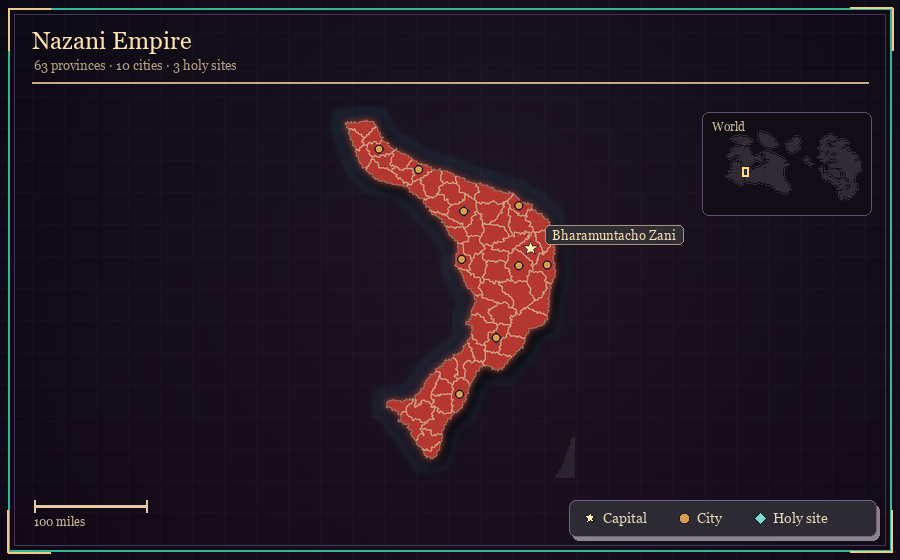
The Nazani Empire, the Western Empire of the Zani, is one of the two states that emerged from the Great Split of 690 LC after the Great Collapse. It is led by the Weagelians, descendants of Geallian invaders and native peoples of Weagelia, and ruled by the House of Nazani.
Identity
Unlike their eastern rivals the Razani, who preserve Imperial Zanic at court, the Nazani are known among their people as Emperors of the West first and foremost. Three centuries of comparatively stable rule have given them a reputation as more than a cadet branch of the Zani family.
The Nazani still claim the Zani inheritance, but their imperial identity has become regional, western, and Weagelian. This distinction helps explain why they can be both successors of Zanis and rivals to other Zanic claimants.
Losses and Consolidation
Nazani stability came at a cost. In 697 LC, they lost the Borderlands to native rebels. In 795 LC, they lost Kainaxarthos to the rising Soventeir Empire. The Marshlands became the empire's lingering wound, repeatedly pacified and repeatedly lost until the disasters around Telamon forced the issue into the open.
In response, the cautious emperor turned inward. The state developed cities and farmland, filled its military ranks, and sought influence through subtler methods. The Nazani are said to secretly fund Orcish colonies destabilizing Borderlander and Celtican tribes, positioning themselves to reconquer the divided Borderlands when the opportunity comes.
Situation at 1000 LC
With few rivals able to match their strength and only scattered Helluvian communities troubling their religious unity, the Nazani are poised to become one of Omniluxia's Great Powers.
The current emperor, Martios Nazani, recognizes the existential problems facing his realm but is overwhelmed by responsibility. Frustrated by limited resources and the hand he inherited, he has wasted opportunities a bolder ruler might have seized. His 994 LC Treaty of Telamon ended the war with the Marshlanders, but many soldiers remember it as a surrender signed just as imperial arms were recovering.
His unpopularity at court is mirrored by the army. Many soldiers in the praesental legion would rather see their commander, the charismatic warrior Renos Nazani, sit on the Purple Throne. Renos's victories with the Gonessionem VII "Weagalia" after the Battle of Telamon made him the living symbol of the war Martios chose to end.
See also: Martios Nazani, Renos Nazani, Zani Empire, Razani Empire, Geallian, Borderlands, Soventeir Empire, and Orc.
Campaign Profile
Nazani Empire begins in Bharamuntacho Zani as an Imperium state led by a Weagelian political core and professing The First Emperor. Its opening position is best understood through the people, ruler, land, and institutions recorded in the game files.
Starting Ruler
Martios Nazani is the fixed, authored ruler at campaign start, born in 974 LC. The setup records Martial 8, Charisma 4, Finesse 2, Zeal 7; the authored traits are Tactically Inflexible, Tactician, Tolerant, Cautious, Blood of the Nazani, and Magically Inept. This is a canonical opening character, not a randomly generated officeholder.
Peoples and Cultural World
Weagelian belongs to the Geallian culture group, alongside Eageli, Ytali, Enentan, Gunstris, Shwi, Shewesnep, Weageli, Ularian, Fideli, Yizerritha, and Shanuza. The culture definition uses the Gellaian ethnicity set for character appearance. Across the realm's starting provinces, population-weighted provincial culture is recorded as Weageli (48%), Ularian (26%), Fideli (23%), Mezhini (2%), Acobelani (2%). The setup additionally grants explicit status to Ularian (Citizen), and Fideli (Citizen). Provincial culture is a broad administrative label rather than a census of every household, but it provides firmer evidence than assuming the entire country matches its court.
Religion in the Realm
The state faith is The First Emperor. Starting provinces are recorded as Zanisite (75%), Lupinite (21%), Helluvian (4%). Game localization describes it this way: “The Imperial Pantheon of Zanis, the first Emperor of the Zani, persists in the Zani peoples who descend from him. Zanis continues to protect his people as a half-god, and the Zanisite Faith focuses upon honoring the memory and achievements of the greatest Zani Emperor with a series of rituals that ensures his divine presence remains within the land.”
Land, Settlements, and Livelihood
At the 1000 LC start it controls 63 provinces, making it a great territorial power. From Bharamuntacho Zani, its government must administer distant communities as well as defend a long frontier. Province count measures the opening political footprint, not the number or worth of its people. The starting provinces contain 10 cities or metropolises. Their population-weighted terrain is plains (35%), farmland (28%), forest (27%), and hills (5%); their leading trade goods are cloth (19%), grain (12%), stone (10%), wood (9%), fish (8%), and wine (5%). These records give the country's culture a material setting without inventing unsupported customs.
Government and Army
Its Imperium locates formal power in a crown and dynasty. The title is therefore more than flavor: succession and the standing of the ruling house are central to the realm's continuity.
The levy is built chiefly around light infantry (55%), supported by heavy infantry (30%), light cavalry (15%). This is a statement about the forces available at the campaign opening, not a claim that every inhabitant shares a single martial way of life.
The army profile should be read together with the terrain and economy above: it shows what the state can raise in 1000 LC, while the province records show the communities and resources supporting that force.
See also: Countries, Cultures, Races, Religions, and Timeline.
Realm at a Glance
Nazani Empire enters the 1000 LC world from Bharamuntacho Zani, with a Weagelian political core and The First Emperor as its recorded faith. Those labels connect the state to Geallian history and to Zanic tradition; they describe the court and starting state, not a claim that every subject has the same ancestry, language, or belief.
Rule and Scale
Its Imperium locates formal power in a crown and dynasty. The title is therefore more than flavor: succession and the standing of the ruling house are central to the realm's continuity.
At the 1000 LC start it controls 63 provinces, making it a great territorial power. From Bharamuntacho Zani, its government must administer distant communities as well as defend a long frontier. Province count measures the opening political footprint, not the number or worth of its people.
People and Belief
Primary culture and state faith show which traditions possess official standing at the campaign opening. They also provide the safest canon-grounded starting point for understanding daily identity: Weagelian institutions shape the realm's public face, while The First Emperor supplies its formal religious vocabulary. Border communities, minorities, and local practice may be more varied than those state labels can show; see Cultures and Races for the distinction between culture and ancestry.
Ways of War
The levy is built chiefly around light infantry (55%), supported by heavy infantry (30%), light cavalry (15%). This is a statement about the forces available at the campaign opening, not a claim that every inhabitant shares a single martial way of life.
Together, the capital, territorial footprint, political form, and levy make Nazani Empire more than a colored patch on the atlas: they define the problems its rulers face and the resources with which its people meet them.
See also: Countries, Timeline, Geallian, and Zanic tradition.