
Soventeir Empire
- Game Tag
- SOV
- Capital
- Soveneria
- Ruler
- Aonghullean Soveneria
- Government
- Imperium
- Primary Culture
- Sovenerian
- Faith
- Helluvian
- Territory
- 43 controlled provinces at start.
- Levy Composition
- Light Infantry 36%, Archers 27%, Horse Archers 18%, Light Cavalry 18%
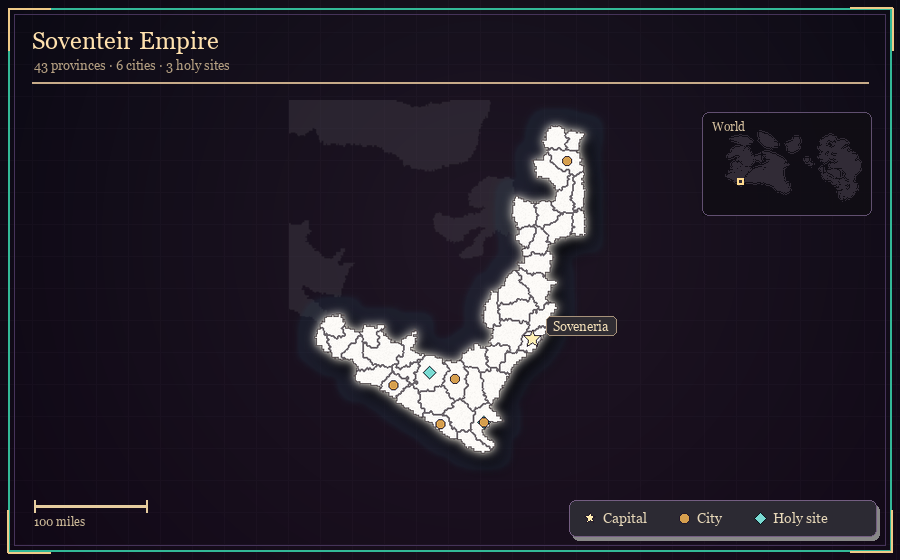
The Soventeir Empire is the empire of the Zanic Dragkhans, formed from Dragkhanic clans living under the shadow of the Celica Mountains in southern Morrigon. It is one of the clearest examples of a non-Zani power claiming Zanic imperial inheritance.
- Tag
- SOV
- Founded
- 852-868 LC, as Sovenerian dominance became imperial rule and Uttarasmake was declared Qhagan.
- Heartland
- Southern Morrigon under the Celica Mountains, especially Kainaxarthos.
- Faith
- Helluvianism, adopted by Uttarasmake in 874 LC and tied to Zanic imperial claims.
- Levy Profile
- Dragkhanic: light infantry and archers, with strong horse archer and light cavalry arms.
Origins
Before the empire, the Sovenerians were one Dragkhanic clan among many in southern Morrigon. Their opportunity came during the Second Marshlander Revolt, when hordes of Dragkhanic horsemen exploited the weakening of Nazani control and invaded the wealthy province of Kainaxarthos.
The Nazani-Sovenerian War ended with the Nazani retreat from southern Morrigon in 795 LC. By 852 LC, the Sovenerians dominated the region and had begun turning conquest into imperial structure.
Uttarasmake the Great
Uttarasmake the Great was declared Qhagan in 868 LC. A Zanophile educated by Helluvian missionaries, he promoted Geallian Kainaxari culture and attempted to reshape Dragkhanic power through Zanic imperial forms.
In 874 LC, Uttarasmake converted to Helluvianism, spread the faith through the empire, and declared himself Shanuzushanuz. By claiming to be the legitimate heir of the Zani Empire, he linked Dragkhanic rulership, Geallian culture, and Helluvian legitimacy into a single imperial project.
Society and Tensions
The Soventeir Empire contains a persistent divide between traditionalist Dragkhanic subjects and the Zanicized imperial court. Its rulers benefited from the prestige of Zani institutions and Helluvian religion, but those same choices alienated clans who remembered older steppe customs and distrusted courtly corruption.
The empire's military culture remains deeply Dragkhanic. Mounted warfare, clan loyalty, and martial reputation still matter, even when officials speak in Zanic titles and claim the mantle of imperial civilization.
Situation at 1000 LC
Centuries of prosperity have bred corruption and complacency. The young Shanuzushanuz, declared in 999 LC, has vowed to banish corrupt officials and raise the empire to new heights. His brother's claim is backed by entrenched officials, traditionalist Dragkhans are restless, and rumors of a Hobgoblin horde swelling in the north threaten the empire's fragile confidence.
Main Cities and Military
Kainaxarthos is the empire's key conquest and the richest symbol of its Zanic inheritance. Its army still looks to the steppe: light infantry and archers screen mobile forces, while horse archers and light cavalry give Soventeir its raiding speed and battlefield reach.
See also: Uttarasmake, Dragkhan, Nazani Empire, Helluvianism, and Zani Empire.
Campaign Profile
Soventeir Empire begins in Soveneria as an Imperium state led by a Sovenerian political core and professing Helluvian. Its opening position is best understood through the people, ruler, land, and institutions recorded in the game files.
Starting Ruler
Aonghullean Soveneria is the fixed, authored ruler at campaign start, born in 976 LC. The setup records Martial 9, Charisma 3, Finesse 5, Zeal 7; the authored traits are Tactician, Tolerant, Founder, Lustful, Brave, Blood of Uttarasmake the Great, and Magically Inept. This is a canonical opening character, not a randomly generated officeholder.
Peoples and Cultural World
Sovenerian belongs to the Sovenerian Dunydurceg culture group, alongside Yexisi, Tuwantuwar, Xagasisi, Dunduyar, and Turayesho. The culture definition uses the Dunydurceg ethnicity set for character appearance. Across the realm's starting provinces, population-weighted provincial culture is recorded as Peinxa (43%), Sovenerian (23%), Kaixa (17%), Yuxiresh (6%), Tuwantuwar (3%). The setup additionally grants explicit status to Kaixa (Citizen), and Peinxa (Citizen). Provincial culture is a broad administrative label rather than a census of every household, but it provides firmer evidence than assuming the entire country matches its court.
Religion in the Realm
The state faith is Helluvian. Starting provinces are recorded as Helluvian (90%), Dragkhanic (10%). Game localization describes it this way: “The Helluvian Church claims to serve the one true god, the 'Creator of All Things That Can Never Be Known', commonly referred to as 'Hellas'. As well as Hellas, the Helluvians honor Helluvius, the demi-god son of Hellas who preached his word until he ultimately sacrificed his own life to save the souls of all intelligent beings. While the Church has expanded under the guidance of the Shannahs, the spiritual leaders of the faith who reside in the Holy City of Ddu-Nuinop, their authority and faith have been challenged by both heretics and heathens, most…”
Land, Settlements, and Livelihood
At the 1000 LC start it controls 43 provinces, making it a major regional state. From Soveneria, its government must coordinate several local centers while protecting a substantial frontier. Province count measures the opening political footprint, not the number or worth of its people. The starting provinces contain 6 cities or metropolises. Their population-weighted terrain is farmland (52%), plains (34%), forest (8%), and hills (5%); their leading trade goods are cloth (11%), iron (11%), base metals (10%), silk (9%), grain (8%), and wood (7%). These records give the country's culture a material setting without inventing unsupported customs.
Government and Army
Its Imperium locates formal power in a crown and dynasty. The title is therefore more than flavor: succession and the standing of the ruling house are central to the realm's continuity.
The levy is built chiefly around light infantry (36%), supported by archers (27%), horse archers (18%), light cavalry (18%). This is a statement about the forces available at the campaign opening, not a claim that every inhabitant shares a single martial way of life.
The army profile should be read together with the terrain and economy above: it shows what the state can raise in 1000 LC, while the province records show the communities and resources supporting that force.
See also: Countries, Cultures, Races, Religions, and Timeline.
Realm at a Glance
Soventeir Empire enters the 1000 LC world from Soveneria, with a Sovenerian political core and Helluvian as its recorded faith. Those labels connect the state to the wider cultural record history and to Helluvian tradition; they describe the court and starting state, not a claim that every subject has the same ancestry, language, or belief.
Rule and Scale
Its Imperium locates formal power in a crown and dynasty. The title is therefore more than flavor: succession and the standing of the ruling house are central to the realm's continuity.
At the 1000 LC start it controls 43 provinces, making it a major regional state. From Soveneria, its government must coordinate several local centers while protecting a substantial frontier. Province count measures the opening political footprint, not the number or worth of its people.
People and Belief
Primary culture and state faith show which traditions possess official standing at the campaign opening. They also provide the safest canon-grounded starting point for understanding daily identity: Sovenerian institutions shape the realm's public face, while Helluvian supplies its formal religious vocabulary. Border communities, minorities, and local practice may be more varied than those state labels can show; see Cultures and Races for the distinction between culture and ancestry.
Ways of War
The levy is built chiefly around light infantry (36%), supported by archers (27%), horse archers (18%), light cavalry (18%). This is a statement about the forces available at the campaign opening, not a claim that every inhabitant shares a single martial way of life.
Together, the capital, territorial footprint, political form, and levy make Soventeir Empire more than a colored patch on the atlas: they define the problems its rulers face and the resources with which its people meet them.
See also: Countries, Timeline, the wider cultural record, and Helluvian tradition.