
Kingdom of Edis (Qoes)

- Game Tag
- SR4
- Capital
- Bad-Furqorin
- Ruler
- Burglesmee
- Government
- Despotic Monarchy
- Primary Culture
- Qoesindu
- Faith
- The Old Father Stone
- Territory
- 3 controlled provinces at start.
- Levy Composition
- Light Infantry 35%, Chariots 23%, Archers 23%, Heavy Infantry 19%
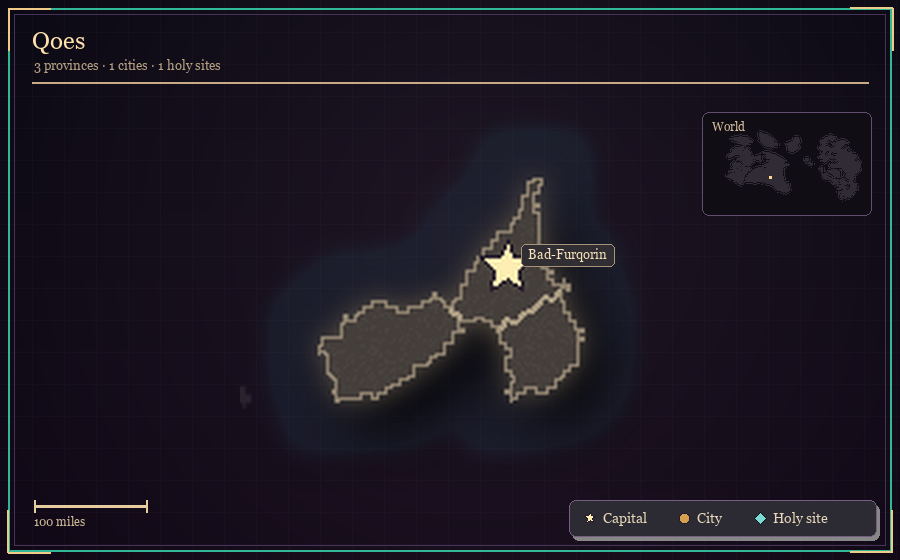
The Kingdom of Edis, also called Qoes, is the realm of the Copper Dwarves on the Skyreach Steppes. It survives behind the walls of Bad-Furqorin, a wealthy but vulnerable city built where the steppes meet the Skyreach Mountains.
Founding
The kingdom was founded in 773 LC by Edis the Grim, a Copper Dwarven adventurer who assembled an army of mercenaries and descended from the Skyreach Mountains. He launched a surprise invasion of the Skyreach Steppes, pushed back Goblin and Selaskusian tribes, and created Qoes in lands once tied to ancient Anempanso.
In 775 LC, the capital Bad-Furqorin was built on farmlands near the mountains. Within a few years it became the most important city in the region.
The City of Cinnabar
Bad-Furqorin sits atop a vast cinnabar mine. The rare mineral made the capital famous as the City of Cinnabar and drew merchants from Luxterra, Morrigon, and the surrounding steppe.
This wealth comes at a cost. Fields given over to mining reduce local food production, so famine and food insecurity remain constant threats. The kingdom owes its survival to two things: the walls of Bad-Furqorin and the swords of the Edis clan.
Edis as Founder and Patron
Edis died in 836 LC, and his tomb was constructed in Bad-Furqorin. The kingdom venerates him as its patron deity or founder-saint, and the Temple of Edis draws pilgrims to the capital.
This cult gives Qoes a sacred identity separate from older dwarven founder traditions. Where Frei and Dwadais represent ancient Copper Dwarven origins, Edis represents survival after collapse, reconquest, and a new Copper Dwarven claim to the Skyreach Steppes.
Ambition and Enemies
The rulers of Qoes dream of proclaiming the Edisdor, the reborn Kingdom of Edis, and of bringing the sacred Skyreach Stone Altar to Bad-Furqorin. Their enemies are the surrounding Ta'ata Goblins and Selaskusians, who threaten the kingdom's exposed farmlands and trade routes.
In a break from traditional dwarven distrust of magic, later rulers invite mages into Bad-Furqorin to learn what they can. This pragmatism reflects the kingdom's precarious position: Qoes cannot afford to ignore any tool that may keep it alive.
See also: Copper Dwarves, Anempanso, Dwarven Grandlands, Goblin, and Luxterra.
Campaign Profile
Kingdom of Edis (Qoes) begins in Bad-Furqorin as a Despotic Monarchy state led by a Qoesindu political core and professing The Old Father Stone. Its opening position is best understood through the people, ruler, land, and institutions recorded in the game files.
Starting Ruler
Burglesmee is the fixed, authored ruler at campaign start, born in 971 LC. The setup records Martial 6, Charisma 7, Finesse 7, Zeal 6; the authored traits are Ambitious, and Blood of Edis the Grim. This is a canonical opening character, not a randomly generated officeholder.
Peoples and Cultural World
Qoesindu belongs to the Copper Dwarf culture group, alongside Qoesies, Varglon, Nofurian, Kankolmie, Dureban, Khenghargio, Dragokhar, Daerinioc, Zavahudim, Anatupampa, Ashuyag, and Amdaftra. The culture definition uses the Common Dwarves ethnicity set for character appearance. Across the realm's starting provinces, population-weighted provincial culture is recorded as Qoesindu (100%). Provincial culture is a broad administrative label rather than a census of every household, but it provides firmer evidence than assuming the entire country matches its court.
Religion in the Realm
The state faith is The Old Father Stone. Starting provinces are recorded as Hebric (100%). Game localization describes it this way: “The Hebric religion of the Copper Dwarves is the most widespread of the three denominations. They believe that Frei and Dwadais are the true heirs of the Stone Father, and their pantheon is filled with ancient dwarf-heroes of yore that ascended into godhood via their virtuous and mighty deeds; a promise to every dwarf that they, too, can hope to become like the gods themselves. Prolific traders, their faith has been spread across Omniluxia, and although there are some humans that have converted to their ways, it remains mostly a dwarven faith.”
Land, Settlements, and Livelihood
At the 1000 LC start it controls 3 provinces, making it a small and exposed polity. From Bad-Furqorin, its government must survive through concentration, timing, and selective expansion. Province count measures the opening political footprint, not the number or worth of its people. The starting provinces contain 1 city or metropolis. Their population-weighted terrain is farmland (70%), plains (19%), and hills (11%); their leading trade goods are cinnabar (70%), iron (19%), and marble (11%). These records give the country's culture a material setting without inventing unsupported customs.
Government and Army
Its Despotic Monarchy locates formal power in a crown and dynasty. The title is therefore more than flavor: succession and the standing of the ruling house are central to the realm's continuity.
The levy is built chiefly around light infantry (35%), supported by chariots (23%), archers (23%), heavy infantry (19%). This is a statement about the forces available at the campaign opening, not a claim that every inhabitant shares a single martial way of life.
The army profile should be read together with the terrain and economy above: it shows what the state can raise in 1000 LC, while the province records show the communities and resources supporting that force.
See also: Countries, Cultures, Races, Religions, and Timeline.
Realm at a Glance
Kingdom of Edis (Qoes) enters the 1000 LC world from Bad-Furqorin, with a Qoesindu political core and The Old Father Stone as its recorded faith. Those labels connect the state to the wider cultural record history and to Dwarven religious tradition; they describe the court and starting state, not a claim that every subject has the same ancestry, language, or belief.
Rule and Scale
Its Despotic Monarchy locates formal power in a crown and dynasty. The title is therefore more than flavor: succession and the standing of the ruling house are central to the realm's continuity.
At the 1000 LC start it controls 3 provinces, making it a small and exposed polity. From Bad-Furqorin, its government must survive through concentration, timing, and selective expansion. Province count measures the opening political footprint, not the number or worth of its people.
People and Belief
Primary culture and state faith show which traditions possess official standing at the campaign opening. They also provide the safest canon-grounded starting point for understanding daily identity: Qoesindu institutions shape the realm's public face, while The Old Father Stone supplies its formal religious vocabulary. Border communities, minorities, and local practice may be more varied than those state labels can show; see Cultures and Races for the distinction between culture and ancestry.
Ways of War
The levy is built chiefly around light infantry (35%), supported by chariots (23%), archers (23%), heavy infantry (19%). This is a statement about the forces available at the campaign opening, not a claim that every inhabitant shares a single martial way of life.
Together, the capital, territorial footprint, political form, and levy make Kingdom of Edis (Qoes) more than a colored patch on the atlas: they define the problems its rulers face and the resources with which its people meet them.
See also: Countries, Timeline, the wider cultural record, and Dwarven religious tradition.