
Jarenam Empire

- Game Tag
- JRE
- Capital
- Zemmairthia Jarenam
- Ruler
- Sakhir Totrazi
- Government
- Great Ulus
- Primary Culture
- Jarenam
- Faith
- Dragkhan Pantheon
- Territory
- 77 controlled provinces at start.
- Levy Composition
- Light Infantry 36%, Archers 27%, Horse Archers 18%, Light Cavalry 18%
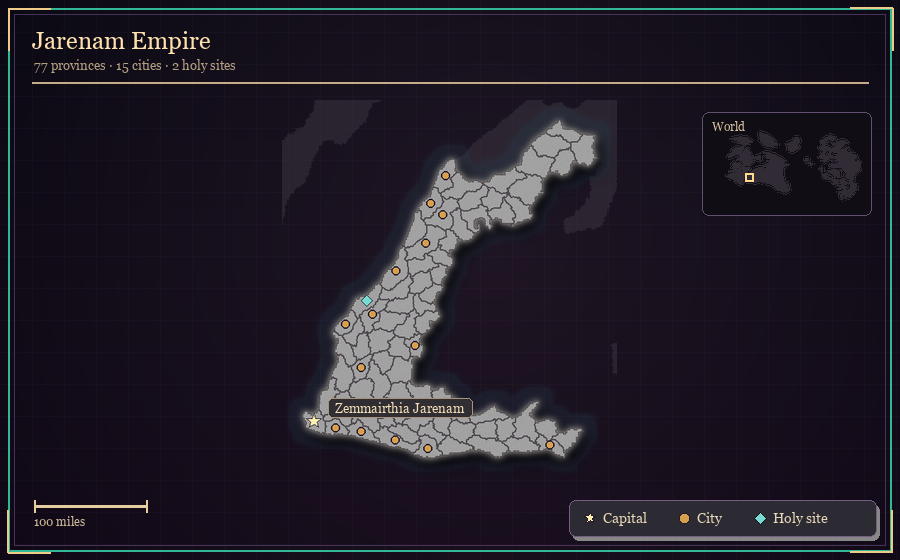
The Jarenam Empire was the realm created by Jarenam the Formidable during his slave revolt and conquest of western Luxterra. It rose from enslaved Yarenamians in Bhaxnmrechtem and, at its height, rivaled the Zani Empire's successor states.
- Tag
- JRE
- Founded
- 977 LC, after Jarenam's revolt at Zemmairthia.
- Capital Memory
- Zemmairthia, the revolt's bloody starting point; later rule was contested by generals and Totrazi successors.
- Faith
- A conquered imperial mixture, shaped by Yarenamian, Etaredican, Phanician, and Baetepian lands.
- Levy Profile
- Etaredican: mass light infantry and heavy infantry, backed by heavy cavalry and chariots.
Rise
The empire began in 977 LC, when Jarenam led Yarenamian slaves in revolt at Zemmairthia, slaughtered the population, and began his conquests. His armies pushed back the Razani and loyal Esquelians, while many Etaredicans joined the revolt against occupying Razani forces.
The campaign transformed western Luxterra. Esquelians were driven from their coastal homeland and flooded into Etaredican lands. In 980 LC, the Kaffarians under Kaffar the Cruel detached from the main force and moved east, founding what became the Kaffarian Kingdom.
Expansion and Limits
By 985 LC, Jarenam's forces reached the Phanicians. Coastal peoples mostly surrendered peacefully, while mountain kingdoms that resisted were crushed. In 987 LC, Jarenam reached the Baetep and conquered much of Lower Baetep.
The empire's expansion ended at Gesma. In 989 LC, Jarenam was decisively defeated by the Razani at the Battle of Gesma and spent the rest of his reign suppressing rebellions. The defeat exposed how difficult it was to hold his conquests without constant personal military pressure.
Succession Crisis
Jarenam died of illness in 993 LC without naming a successor. A crisis erupted among generals, nobles, pretenders, and conquered peoples. Several territories broke away, including the Phanicians and Baetepians, while the Razani were too weak to reconquer them.
In 998 LC, the House of Totrazi seized control under Sakhir Totrazi, but the realm remained unstable. Jarenam's personal empire had become a contested dynastic state.
Main Cities and Military
The empire's decisive places are its origin at Zemmairthia, the western Luxterran lands that joined the revolt, the Phanician coast that mostly surrendered, Lower Baetep, and Gesma, where Jarenam's expansion was checked in 989 LC. Its levy profile is heavy for a post-revolt conquest state: a light infantry mass backed by heavy infantry, heavy cavalry, and chariots, matching a realm built for shock campaigns and occupation.
See also: Invasions of Jarenam the Formidable, Jarenam, Sakhir Totrazi, Razani Empire, Kingdom of Dune, and Timeline.
Campaign Profile
Jarenam Empire begins in Zemmairthia Jarenam as a Great Ulus state led by a Jarenam political core and professing Dragkhan Pantheon. Its opening position is best understood through the people, ruler, land, and institutions recorded in the game files.
Starting Ruler
Sakhir Totrazi is the fixed, authored ruler at campaign start, born in 976 LC. The setup records Martial 9, Charisma 3, Finesse 5, Zeal 8; the authored traits are Tactician, Conqueror, Cruel, Zealous, Steadfast, Brave, and Blood of the Totrazi. This is a canonical opening character, not a randomly generated officeholder.
Peoples and Cultural World
Jarenam belongs to the Jazari Dunydurceg culture group, alongside Kaffarian, and Jazari. The culture definition uses the Kharesmian ethnicity set for character appearance. Across the realm's starting provinces, population-weighted provincial culture is recorded as Oxan (25%), Exan (14%), Jazari (13%), Domekiri (9%), Pasuwan (6%). The setup additionally grants explicit status to Maphirian (Citizen), and Bhaxian (Citizen). Provincial culture is a broad administrative label rather than a census of every household, but it provides firmer evidence than assuming the entire country matches its court.
Religion in the Realm
The state faith is Dragkhan Pantheon. Starting provinces are recorded as Helluvian (39%), Zainudian (36%), Dragkhanic (14%), Zanisite (4%), Viktreic (4%). Game localization describes it this way: “The Dragkhanic religion is the worship of the self, where one's own desires and wants are the only thing in the universe that matters. Rewards are given only to those who will take them and nothing is assured in this life except for one's own death; a dark philosophy that has many nihilistic connotations for the Dragkhanic faithful. Dragkhanic gods are creatures of cruelty and despair, leading armies of misery against the armies of good.”
Land, Settlements, and Livelihood
At the 1000 LC start it controls 77 provinces, making it a great territorial power. From Zemmairthia Jarenam, its government must administer distant communities as well as defend a long frontier. Province count measures the opening political footprint, not the number or worth of its people. The starting provinces contain 15 cities or metropolises. Their population-weighted terrain is farmland (32%), plains (25%), mountain (21%), and hills (10%); their leading trade goods are cloth (11%), earthenware (8%), grain (6%), wine (6%), base metals (6%), and meat (6%). These records give the country's culture a material setting without inventing unsupported customs.
Government and Army
Its Great Ulus locates formal power in a crown and dynasty. The title is therefore more than flavor: succession and the standing of the ruling house are central to the realm's continuity.
The levy is built chiefly around light infantry (36%), supported by archers (27%), horse archers (18%), light cavalry (18%). This is a statement about the forces available at the campaign opening, not a claim that every inhabitant shares a single martial way of life.
The army profile should be read together with the terrain and economy above: it shows what the state can raise in 1000 LC, while the province records show the communities and resources supporting that force.
See also: Countries, Cultures, Races, Religions, and Timeline.
Realm at a Glance
Jarenam Empire enters the 1000 LC world from Zemmairthia Jarenam, with a Jarenam political core and Dragkhan Pantheon as its recorded faith. Those labels connect the state to the wider cultural record history and to Dragkhan religious tradition; they describe the court and starting state, not a claim that every subject has the same ancestry, language, or belief.
Rule and Scale
Its Great Ulus locates formal power in a crown and dynasty. The title is therefore more than flavor: succession and the standing of the ruling house are central to the realm's continuity.
At the 1000 LC start it controls 77 provinces, making it a great territorial power. From Zemmairthia Jarenam, its government must administer distant communities as well as defend a long frontier. Province count measures the opening political footprint, not the number or worth of its people.
People and Belief
Primary culture and state faith show which traditions possess official standing at the campaign opening. They also provide the safest canon-grounded starting point for understanding daily identity: Jarenam institutions shape the realm's public face, while Dragkhan Pantheon supplies its formal religious vocabulary. Border communities, minorities, and local practice may be more varied than those state labels can show; see Cultures and Races for the distinction between culture and ancestry.
Ways of War
The levy is built chiefly around light infantry (36%), supported by archers (27%), horse archers (18%), light cavalry (18%). This is a statement about the forces available at the campaign opening, not a claim that every inhabitant shares a single martial way of life.
Together, the capital, territorial footprint, political form, and levy make Jarenam Empire more than a colored patch on the atlas: they define the problems its rulers face and the resources with which its people meet them.
See also: Countries, Timeline, the wider cultural record, and Dragkhan religious tradition.