
The Kingdoms of Rohenoa and Rohevia
- Game Tag
- ARL
- Capital
- Racgerrac
- Ruler
- Merowig Merovingi
- Government
- Aristocratic Monarchy
- Primary Culture
- Aralan
- Faith
- Helluvian
- Territory
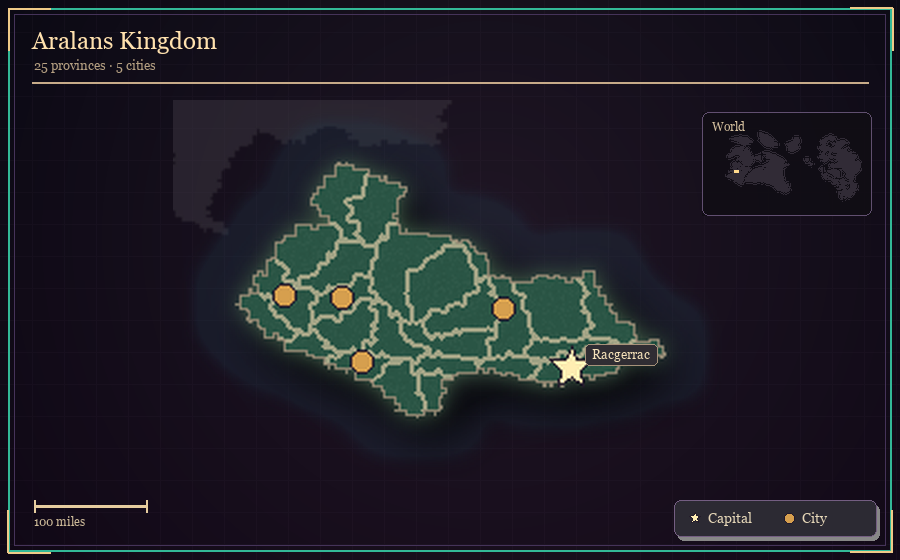
- 25 controlled provinces at start.
- Levy Composition
- Light Infantry 50%, Heavy Infantry 25%, Heavy Cavalry 15%, Light Cavalry 10%
North of the impassable Rohanoan Mountains lies the Rohenevian Peninsula, a chivalrous land of knights and kings, lords and ladies, castles and cities. Its rival realms are the subject of hundreds of songs, ballads, and courtly tales.
The Peninsula
Rohenoa and Rohevia sit on the northern edge of the old Zani world, close enough to be drawn into imperial tribute systems but far enough away to preserve strong local traditions. The region's mountains, valleys, and fortified settlements helped produce a political culture centered on noble houses, martial reputation, and regional loyalties.
During the late Zanic period, Rohenoan and Rohevian client states rebelled as the Zani Empire weakened. In 620 LC, while the Zani invaded Srrorum, Rohenoan and Rohevian clients stopped paying tribute, helping bring the Pax Zanica to an end.
The Realms
The two strongest Rohenoan kingdoms dominate regional politics: Bretagne and the Aralan-led kingdom. A clash between the two powers and their allies seems imminent. Many distrust the foreign culture of the Aralans, while Bretagne has made enemies since the Great Collapse who would gladly see it fall.
The arrival of the first Aralan mercenaries in Rohenoa in 578 LC helps explain the later Aralan presence. Over time, skilled soldiers and local fealty systems allowed Aralan elites to become deeply involved in southern Rohenevian politics.
Legacy
Rohenoa and Rohevia are important because they show how former Zani client regions developed their own post-imperial identities. Their chivalric culture, rivalry between Bretagne and Aralan-led powers, and memory of tribute rebellion make the peninsula one of Morrigon's most politically charged regions.
See also: Aralans, Morrigon, Zani Empire, Kingdom of Srrorum, Timeline, and Countries.
Campaign Profile
The Kingdoms of Rohenoa and Rohevia begin in Racgerrac as an Aristocratic Monarchy state led by a Aralan political core and professing Helluvian. Its opening position is best understood through the people, ruler, land, and institutions recorded in the game files.
Starting Ruler
Merowig Merovingi is the fixed, authored ruler at campaign start, born in 933 LC. The setup records Martial 13, Charisma 4, Finesse 6, Zeal 8; the authored traits are Tactician, Conqueror, Cruel, Founder, Cancer, Wounded, and Blood of the Merovingi. This is a canonical opening character, not a randomly generated officeholder.
Peoples and Cultural World
Aralan belongs to the Aralans culture group, alongside Aralanoc, Bourges, Poitier, Caerthwaite, Selewine, and Gjiiuloc. The culture definition uses the Aralan ethnicity set for character appearance. Across the realm's starting provinces, population-weighted provincial culture is recorded as Aralanoc (38%), Pademunda (32%), Sumanis (29%), Thiorais (2%). The setup additionally grants explicit status to Sumanis (Citizen). Provincial culture is a broad administrative label rather than a census of every household, but it provides firmer evidence than assuming the entire country matches its court.
Religion in the Realm
The state faith is Helluvian. Starting provinces are recorded as Helluvian (85%), Patreic (12%), Zanisite (3%). Game localization describes it this way: “The Helluvian Church claims to serve the one true god, the 'Creator of All Things That Can Never Be Known', commonly referred to as 'Hellas'. As well as Hellas, the Helluvians honor Helluvius, the demi-god son of Hellas who preached his word until he ultimately sacrificed his own life to save the souls of all intelligent beings. While the Church has expanded under the guidance of the Shannahs, the spiritual leaders of the faith who reside in the Holy City of Ddu-Nuinop, their authority and faith have been challenged by both heretics and heathens, most…”
Land, Settlements, and Livelihood
At the 1000 LC start it controls 25 provinces, making it a substantial middle power. From Racgerrac, its government must turn a meaningful territorial base into durable regional influence. Province count measures the opening political footprint, not the number or worth of its people. The starting provinces contain 5 cities or metropolises. Their population-weighted terrain is farmland (44%), plains (29%), forest (22%), and mountain (3%); their leading trade goods are porcelain (10%), cloth (9%), amber (9%), grain (9%), wild game (8%), and stone (8%). These records give the country's culture a material setting without inventing unsupported customs.
Government and Army
Its Aristocratic Monarchy locates formal power in a crown and dynasty. The title is therefore more than flavor: succession and the standing of the ruling house are central to the realm's continuity.
The levy is built chiefly around light infantry (50%), supported by heavy infantry (25%), heavy cavalry (15%), light cavalry (10%). This is a statement about the forces available at the campaign opening, not a claim that every inhabitant shares a single martial way of life.
The army profile should be read together with the terrain and economy above: it shows what the state can raise in 1000 LC, while the province records show the communities and resources supporting that force.
See also: Countries, Cultures, Races, Religions, and Timeline.
Realm at a Glance
The Kingdoms of Rohenoa and Rohevia enters the 1000 LC world from Racgerrac, with an Aralan political core and Helluvian as its recorded faith. Those labels connect the state to Half-Elven history and to Helluvian tradition; they describe the court and starting state, not a claim that every subject has the same ancestry, language, or belief.
Rule and Scale
Its Aristocratic Monarchy locates formal power in a crown and dynasty. The title is therefore more than flavor: succession and the standing of the ruling house are central to the realm's continuity.
At the 1000 LC start it controls 25 provinces, making it a substantial middle power. From Racgerrac, its government must turn a meaningful territorial base into durable regional influence. Province count measures the opening political footprint, not the number or worth of its people.
People and Belief
Primary culture and state faith show which traditions possess official standing at the campaign opening. They also provide the safest canon-grounded starting point for understanding daily identity: Aralan institutions shape the realm's public face, while Helluvian supplies its formal religious vocabulary. Border communities, minorities, and local practice may be more varied than those state labels can show; see Cultures and Races for the distinction between culture and ancestry.
Ways of War
The levy is built chiefly around light infantry (50%), supported by heavy infantry (25%), heavy cavalry (15%), light cavalry (10%). This is a statement about the forces available at the campaign opening, not a claim that every inhabitant shares a single martial way of life.
Together, the capital, territorial footprint, political form, and levy make The Kingdoms of Rohenoa and Rohevia more than a colored patch on the atlas: they define the problems its rulers face and the resources with which its people meet them.
See also: Countries, Timeline, Half-Elven, and Helluvian tradition.