
Kingdom of Baetep
- Game Tag
- EGY
- Capital
- Yewubdar
- Ruler
- Ara Sertem
- Government
- Egyptian Dynasty
- Primary Culture
- Eagelian
- Faith
- The First Emperor
- Territory
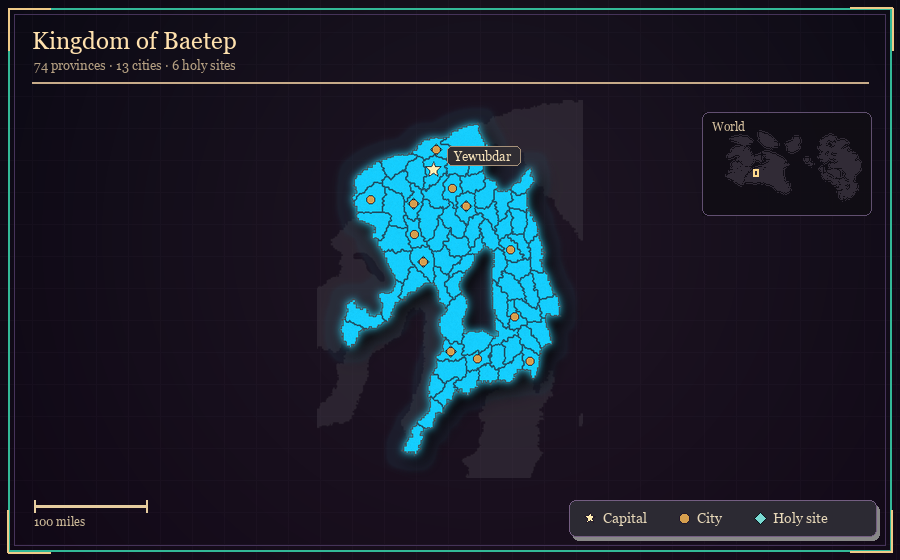
- 74 controlled provinces at start.
- Levy Composition
- Light Infantry 55%, Heavy Infantry 30%, Light Cavalry 15%
The Sertemic Kingdom of Baetep is ruled by the silver-tongued House of Sertem. Despite tying themselves to a legacy older than the Geallians, the Sertem are descended from Zanicized Phanicians who rose through imperial administration.
- Tag
- EGY
- Founded
- After Tzondunnan Sertem seized Baetep amid Razani weakness and Jarenamid pressure.
- Heartland
- Lower Baetep, the administrative and religious prize contested by Sertem and Djedhid claimants.
- Faith
- Officially Zanicized, but native Baetepian worship survives beneath Sertemic rule.
- Levy Profile
- Baetepian: light infantry, light cavalry, heavy infantry, and camel auxiliaries.
History
The Sertem used guile and cunning to be appointed governors of the imperial province of Baetep. Their founder, Srandenr Sertem, had been rewarded by Zanis the Great with the governorship after faithful service.
As the crumbling Razani Empire lost its grip, Tzondunnan Sertem seized Baetep to "secure" it against invading Jarenamid hordes, then claimed the province as the core of his own kingdom.
Situation at 1000 LC
The Sertemic dynasty rules one of the strongest realms in Luxterra and could surpass or even conquer the ailing Razani. Yet Baetepian memory remains dangerous. The people tasted freedom, and the worship of native gods survives despite Zanic and Sertemic suppression.
The Kingdom of Dune, ruled by the True Pharon, keeps alive the Djedhid claim and the dream of native restoration. Ara Sertem has vowed that this restoration will not occur while she rules.
Legacy
Baetep is a contest between administrative survival and native legitimacy. The Sertem can claim order, wealth, and strength, but Dune claims the blood, gods, and throne of old Baetep.
Main Cities and Military
Baetep's major cities are the old river and temple centers that made the province valuable to Zani governors, Jarenamid conquerors, and the Sertem alike. Its levies resemble the native Baetepian pattern: numerous light infantry, a disciplined heavy infantry minority, mobile light cavalry, and camel forces adapted to the southern routes.
See also: Ara Sertem, Kingdom of Dune, Baetepian, Jarenam Empire, Razani Empire, and Countries.
Campaign Profile
Kingdom of Baetep begins in Yewubdar as an Egyptian Dynasty state led by a Eagelian political core and professing The First Emperor. Its opening position is best understood through the people, ruler, land, and institutions recorded in the game files.
Starting Ruler
Ara Sertem is the fixed, authored ruler at campaign start, born in 982 LC. The setup records Martial 3, Charisma 9, Finesse 7, Zeal 5; the authored traits are Tactician, Founder, Ambitious, and Lustful. This is a canonical opening character, not a randomly generated officeholder.
Peoples and Cultural World
Eagelian belongs to the Geallian culture group, alongside Eageli, Ytali, Enentan, Gunstris, Shwi, Shewesnep, Weageli, Ularian, Fideli, Yizerritha, and Shanuza. The culture definition uses the Gellaian ethnicity set for character appearance. Across the realm's starting provinces, population-weighted provincial culture is recorded as Kawsem (36%), Yehan (30%), Hawulti (20%), Nasatan (6%), Shandian (5%). The setup additionally grants explicit status to Kawsem (Citizen), Hawulti (Citizen), Yehan (Citizen), and Shewesnep (Citizen). Provincial culture is a broad administrative label rather than a census of every household, but it provides firmer evidence than assuming the entire country matches its court.
Religion in the Realm
The state faith is The First Emperor. Starting provinces are recorded as Baetepian (44%), Zanisite (42%), Helluvian (10%), Da Ash-Hêbriq (2%), Viktreic (2%). Game localization describes it this way: “The Imperial Pantheon of Zanis, the first Emperor of the Zani, persists in the Zani peoples who descend from him. Zanis continues to protect his people as a half-god, and the Zanisite Faith focuses upon honoring the memory and achievements of the greatest Zani Emperor with a series of rituals that ensures his divine presence remains within the land.”
Land, Settlements, and Livelihood
At the 1000 LC start it controls 74 provinces, making it a great territorial power. From Yewubdar, its government must administer distant communities as well as defend a long frontier. Province count measures the opening political footprint, not the number or worth of its people. The starting provinces contain 13 cities or metropolises. Their population-weighted terrain is floodplain (53%), desert (23%), plains (11%), and oasis (9%); their leading trade goods are earthenware (8%), incense (7%), porcelain (7%), marble (7%), cloth (6%), and dates (6%). These records give the country's culture a material setting without inventing unsupported customs.
Government and Army
Its Egyptian Dynasty locates formal power in a crown and dynasty. The title is therefore more than flavor: succession and the standing of the ruling house are central to the realm's continuity.
The levy is built chiefly around light infantry (55%), supported by heavy infantry (30%), light cavalry (15%). This is a statement about the forces available at the campaign opening, not a claim that every inhabitant shares a single martial way of life.
The army profile should be read together with the terrain and economy above: it shows what the state can raise in 1000 LC, while the province records show the communities and resources supporting that force.
See also: Countries, Cultures, Races, Religions, and Timeline.
Realm at a Glance
Kingdom of Baetep enters the 1000 LC world from Yewubdar, with an Eagelian political core and The First Emperor as its recorded faith. Those labels connect the state to Geallian history and to Zanic tradition; they describe the court and starting state, not a claim that every subject has the same ancestry, language, or belief.
Rule and Scale
Its Egyptian Dynasty locates formal power in a crown and dynasty. The title is therefore more than flavor: succession and the standing of the ruling house are central to the realm's continuity.
At the 1000 LC start it controls 74 provinces, making it a great territorial power. From Yewubdar, its government must administer distant communities as well as defend a long frontier. Province count measures the opening political footprint, not the number or worth of its people.
People and Belief
Primary culture and state faith show which traditions possess official standing at the campaign opening. They also provide the safest canon-grounded starting point for understanding daily identity: Eagelian institutions shape the realm's public face, while The First Emperor supplies its formal religious vocabulary. Border communities, minorities, and local practice may be more varied than those state labels can show; see Cultures and Races for the distinction between culture and ancestry.
Ways of War
The levy is built chiefly around light infantry (55%), supported by heavy infantry (30%), light cavalry (15%). This is a statement about the forces available at the campaign opening, not a claim that every inhabitant shares a single martial way of life.
Together, the capital, territorial footprint, political form, and levy make Kingdom of Baetep more than a colored patch on the atlas: they define the problems its rulers face and the resources with which its people meet them.
See also: Countries, Timeline, Geallian, and Zanic tradition.