
Boraspos
- Game Tag
- DN6
- Capital
- Lakhnghasgh
- Government
- Ulus Monarchy
- Primary Culture
- Derbican
- Faith
- Dragkhan Pantheon
- Territory
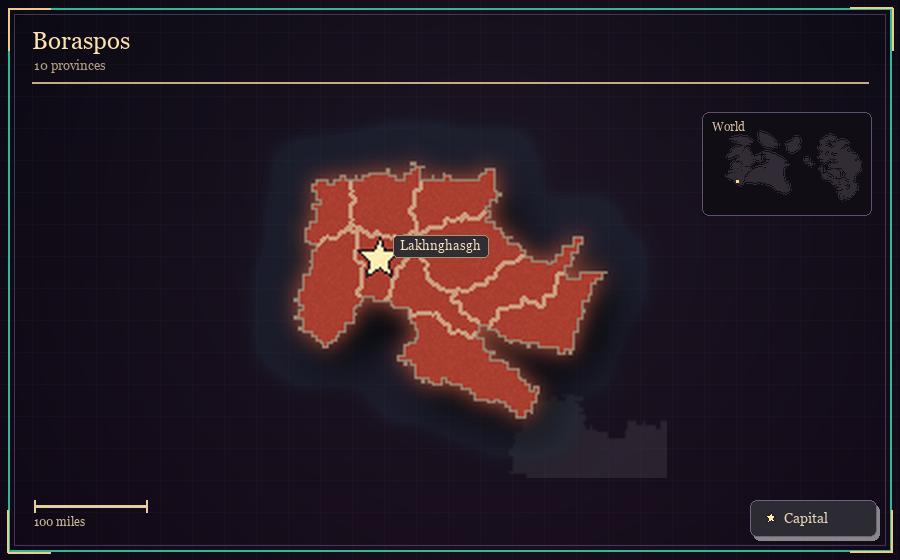
- 10 controlled provinces at start.
- Levy Composition
- Light Infantry 36%, Archers 27%, Horse Archers 18%, Light Cavalry 18%
Campaign Profile
Boraspos begins in Lakhnghasgh as an Ulus Monarchy state led by a Derbican political core and professing Dragkhan Pantheon. Its opening position is best understood through the people, ruler, land, and institutions recorded in the game files.
Starting Ruler
No set_as_ruler character is present for this tag in the authored setup files. Accordingly, no ruler is named here: the campaign supplies the officeholder through game setup rather than fixed lore.
Peoples and Cultural World
Derbican belongs to the Western Dunydurceg culture group, alongside Sinti, Margian, Kayarah, Darmerush, and Yuxiresh. The culture definition uses the Dunydurceg ethnicity set for character appearance. Across the realm's starting provinces, population-weighted provincial culture is recorded as Derbican (89%), Darmerush (11%). Provincial culture is a broad administrative label rather than a census of every household, but it provides firmer evidence than assuming the entire country matches its court.
Religion in the Realm
The state faith is Dragkhan Pantheon. Starting provinces are recorded as Dragkhanic (100%). Game localization describes it this way: “The Dragkhanic religion is the worship of the self, where one's own desires and wants are the only thing in the universe that matters. Rewards are given only to those who will take them and nothing is assured in this life except for one's own death; a dark philosophy that has many nihilistic connotations for the Dragkhanic faithful. Dragkhanic gods are creatures of cruelty and despair, leading armies of misery against the armies of good.”
Land, Settlements, and Livelihood
At the 1000 LC start it controls 10 provinces, making it a compact regional realm. From Lakhnghasgh, its government must use a limited but coherent base carefully. Province count measures the opening political footprint, not the number or worth of its people. The starting provinces contain 0 cities or metropolises. Their population-weighted terrain is plains (61%), and forest (39%); their leading trade goods are grain (24%), furs (20%), wood (18%), cedar (12%), livestock (11%), and hemp (11%). These records give the country's culture a material setting without inventing unsupported customs.
Government and Army
Its Ulus Monarchy locates formal power in a crown and dynasty. The title is therefore more than flavor: succession and the standing of the ruling house are central to the realm's continuity.
The levy is built chiefly around light infantry (36%), supported by archers (27%), horse archers (18%), light cavalry (18%). This is a statement about the forces available at the campaign opening, not a claim that every inhabitant shares a single martial way of life.
The army profile should be read together with the terrain and economy above: it shows what the state can raise in 1000 LC, while the province records show the communities and resources supporting that force.
See also: Countries, Cultures, Races, Religions, and Timeline.
Realm at a Glance
Boraspos enters the 1000 LC world from Lakhnghasgh, with a Derbican political core and Dragkhan Pantheon as its recorded faith. Those labels connect the state to the wider cultural record history and to Dragkhan religious tradition; they describe the court and starting state, not a claim that every subject has the same ancestry, language, or belief.
Rule and Scale
Its Ulus Monarchy locates formal power in a crown and dynasty. The title is therefore more than flavor: succession and the standing of the ruling house are central to the realm's continuity.
At the 1000 LC start it controls 10 provinces, making it a compact regional realm. From Lakhnghasgh, its government must use a limited but coherent base carefully. Province count measures the opening political footprint, not the number or worth of its people.
People and Belief
Primary culture and state faith show which traditions possess official standing at the campaign opening. They also provide the safest canon-grounded starting point for understanding daily identity: Derbican institutions shape the realm's public face, while Dragkhan Pantheon supplies its formal religious vocabulary. Border communities, minorities, and local practice may be more varied than those state labels can show; see Cultures and Races for the distinction between culture and ancestry.
Ways of War
The levy is built chiefly around light infantry (36%), supported by archers (27%), horse archers (18%), light cavalry (18%). This is a statement about the forces available at the campaign opening, not a claim that every inhabitant shares a single martial way of life.
Together, the capital, territorial footprint, political form, and levy make Boraspos more than a colored patch on the atlas: they define the problems its rulers face and the resources with which its people meet them.
See also: Countries, Timeline, the wider cultural record, and Dragkhan religious tradition.